Airbnb in Portugal: The AL Licence Rules and the Selling Tax Surprise
Everyone has had the dream.
You buy a little apartment in Lisbon or a house in the Algarve, list it on Airbnb, and the income rolls in while you sleep. The photos are beautiful. The reviews are glowing. Your spreadsheet looks very convincing.I know this dream well. I lived it.
I bought a short-term rental out of my Príncipe Real apartment in Lisbon, and had a manager run it while I still lived in South Africa. We stayed there when we visited and it earned money while we weren't there. Sounds perfect right? Until it wasn't.
So let me walk you through what the AL licence actually involves, and the selling tax
First, what even is an AL?
Before you list a single night on Airbnb in Portugal, you legally need an Alojamento Local licence, universally known as an AL. This is Portugal's official short-term rental registration, and operating without one, you're in a grey area — and those are always best avoided.
Getting an Alojamento Local licence is not wildly difficult, but it is not exactly easy. You register through the Balcão Único Eletrónico, get a number from your municipality, and are then subject to a set of physical and legal requirements before that number really means anything.

First, the property itself needs to line up with the official records. Is everything legal according to the architectural plans on file at the municipality? Then come the smaller, but equally essential, requirements: fire extinguisher, first aid kit, physical livro de reclamações (complaints book), and signage at the property. And that is just the registration side.
The bigger complication is choosing how to structure the AL for tax purposes, because the way you set it up at the beginning can affect far more than your first tax return.
The licence you want may not exist anymore
Certain parts of Lisbon, Porto, and many other municipalities have been closed to new AL licences for years.
These are the so-called contention zones. Oh and quite the bones of contention they are!
They are essentially areas of high tourist concentration aimed at equaling out the ratio between tourist and residential accommodation. Identified by each individual municipality, these areas are for all sense and purposes "frozen" for new short-term rental registrations.
If the property you're eyeing is in the heart of Lisbon, in a coastal town like Sesimbra or the historic centre of Porto, there is a good chance the answer is simply: no new licence.
This changes. Constantly. The rules around contention zones are adjusted by municipalities periodically, and the national framework has shifted underneath them more than once. The 2023 Mais Habitação housing package created enormous upheaval. It restricted Airbnb-style rentals in ways that then got challenged, reversed, softened, and re-amended.
I've watched the legal landscape around short-term rentals in Portugal shift more times than I've rearranged my living room, which is saying something.
The most recent overhaul came with Decree-Law 76/2024, which took effect in November 2024. The national freeze on new AL registrations that Mais Habitação had introduced was lifted (which sounds like good news) BUT it was replaced with something way more complicated: municipalities were handed full regulatory autonomy to set their own rules, create their own contention zones, and suspend new licences for up to a year while they figured out what those rules would be.
Which is exactly what happened.
Lisbon immediately suspended all new AL licences across the entire city for a year, then introduced a new tiered system dividing the city into absolute contention zones (no new licences where AL density exceeds 10% of housing stock — which covers most of the historic centre and inner belt), relative contention zones, and micro-containment areas.
Porto lifted its blanket freeze but kept hard restrictions in the six central freguesias including Ribeira and Bonfim, while opening up other neighbourhoods.
The Algarve municipalities like Albufeira and Lagos can now designate their own conflict zones in saturated areas. Every city is doing something slightly different, on its own timeline, under its own interpretation of the same national framework.
The practical upshot: always verify whether an AL licence is actually possible for a specific property before you buy it with rental income in mind. Your lawyer, bless them, will check the title documents. They will not necessarily check whether that address sits in a zone where new ALs are frozen.
Ask explicitly, or have a buyer's agent who knows to ask.
And when you do ask, don't expect a simple answer.
There is no central map, no national database, no single government website where you can type in an address and get a reliable yes or no. Each municipality manages its own contention zones, publishes the information differently, and updates it on its own schedule. For some areas you are looking at buried municipal regulations, for others a phone call to the Câmara, and for others still you are relying on someone who knows that specific area well enough to know what questions to ask. I have seen experienced local professionals need to dig to get a straight answer. If anyone tells you it is easy to verify, they have not tried recently.
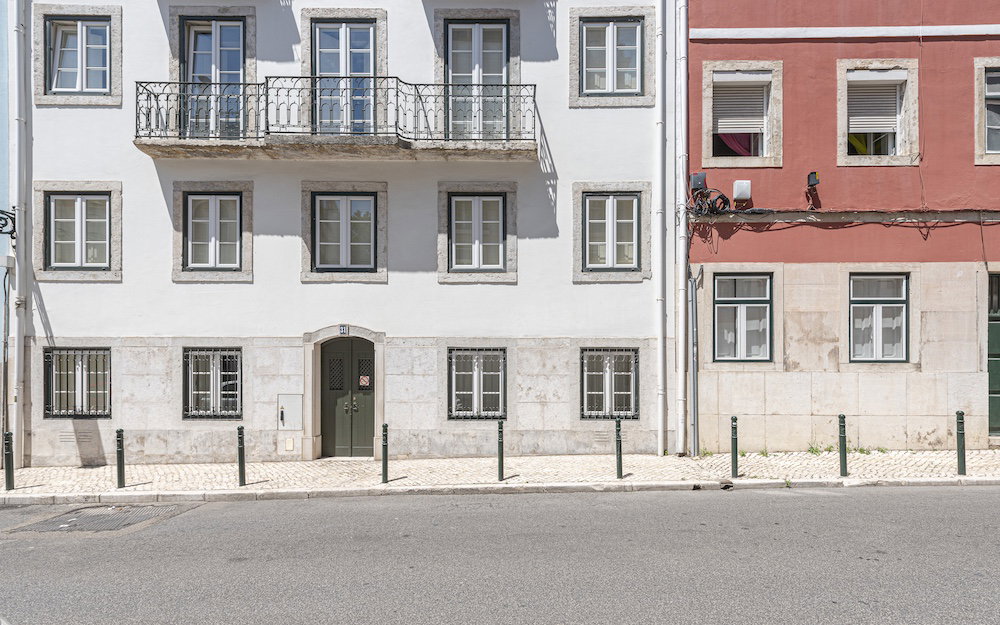
My apartment building front door in Príncipe Réal - the dream!
Lesson Alert!
Initially, when I first bought, there were no restrictions in Príncipe Real. So, to simplify my tax return, I was advised to have the management company apply for the AL registration and then rent the apartment from me.
At the time, this sounded sensible. They would run the short-term rental, I would receive rental income, and I would avoid dealing with the AL as a business activity myself.
Looking back, I am not sure this was the best advice.
What I did not fully understand then is that you do not necessarily need a company to operate an AL in Portugal. An individual can be the AL operator. But if the AL is in your name and you are the person legally operating it, you normally need to "open a business activity" with Finanças (the tax authority) for the accommodation activity. In tax terms, that usually means Category B income, not just ordinary rental income.
The cleaner distinction is this:
If the AL is in your name, the management company is usually just managing your AL. You remain the operator. You receive the guest income, declare the AL activity, and the manager invoices you for their fee.
If the management company rents the apartment from you and operates the AL itself, then the company is the operator. It receives the guest income, deals with the AL business, and you receive rent from the company.
That second model can be simpler for the owner, but it also means you may not control the AL registration in the same way. And in a world where new AL registrations can later be frozen or restricted, that detail did become much more important than it seemed at the time. Once I had moved to Portugal and settled in with the language and the admin, I wanted to run the Airbnb myself but I could not do so under the AL regime because I could not get an AL licence in my name.
Your building could vote you out
Since 2023, condominium associations have had the right to object to Alojamento Local operations in their building. That objection needs to be supported by more than 50% of owners.
BUT here is what most people don't realise: this is not a one-time hurdle you clear and forget about. Condominiums hold their annual general meeting every year, and every year the question of whether to allow AL in the building can come up again. A building that was fine with short-term rental when you bought could vote it out twelve months later. And the year after that. It only takes a shift in the mood of the building, a few new owners, or one persistent neighbour with a grudge about suitcase noise.
I've seen this play out. The building culture matters as much as the legal framework. It's worth having a genuine read of the condominium before you buy. Not only just checking whether AL is currently permitted, but getting a sense of whether the owners are broadly in favour or merely tolerating it. Those are very different situations.
The operational grind nobody photographs
Let's say you get the AL licence and your building is on board. Wonderful. Now the work starts.
Tourist tax. You are required to collect the taxa turística from each guest, per person, per night. The rate varies by municipality. You collect it, you keep records, you remit it. Every. Municipality. Has. Its. Own. Rules.
Guest registration. Every guest's passport details must be submitted to the Portuguese authorities within 3 days of check-in. Every guest. This is done through a government portal that is, to put it diplomatically, not built for the user experience. It crashes. It times out. It requires specific formatting. It is absolutely mandatory.
Compulsory insurance. Standard home insurance does not cover short-term rental activity in Portugal. You need a specific multi-risk policy that includes liability coverage for guests. This is a legal requirement, not a nice-to-have.
VAT. If you are a non-resident running an Airbnb in Portugal, you must register for VAT, charge it to guests, and file quarterly returns. If you are a resident and your AL income crosses certain thresholds, you may also find yourself in VAT territory. This is the part where people look at their accountant with the expression of someone who has just found an unexpected ingredient in their dinner.
The exit trap: Portugal's most expensive Airbnb surprise
This is the one I really want you to sit with, because it's the least-known and most expensive part of the whole picture.
The moment you register a property as an Alojamento Local, the Portuguese tax authorities reclassify it. It moves, in their eyes, from a personal asset to a business asset. This fundamentally changes how capital gains tax in Portugal is calculated when you eventually sell.
Normally, as a Portuguese tax resident selling a property, 50% of your capital gain is excluded from tax. That is a significant relief. Under the AL reclassification, you lose that. The gain is treated as business income, calculated differently, with fewer deductions available.
The only way out of this?
Deregister your AL and wait three years before selling.Three years of the property not operating as a short-term rental before the Portuguese tax authorities will treat the sale as a personal asset disposal again.

Most people buying an investment property in Portugal with Airbnb income in mind have no idea they're making a tax election the moment they register. The dream is: rent it out for a few years, sell it for a profit. The reality is: rent it out for a few years, sell it, and find that the Portugal property tax calculation is nothing like what your spreadsheet suggested.
Unless you planned the exit three years in advance.
I will say it plainly: talk to a Portuguese tax accountant before you register an AL, not after. This one conversation could be worth more than everything else in this article.
One genuinely useful change
I don't want to make this all sound like a bureaucratic horror story, because it isn't. Portugal has been adjusting the rules, and one change from the same November 2024 decree is actually quite sensible: AL licences are now transferable when you sell a property. If the licence exists, it can go with the building.
For buyers looking at properties in frozen zones, this is meaningful.
Buying a Portugal investment property that already has an active Alojamento Local licence is now explicitly a transferable asset. That changes valuations, and it changes strategy.
So should you do it?
Short-term rental in Portugal can work really well. I did it. I'd approach it differently now, but I don't regret it. The Lisbon market is strong, demand is real, and done properly, the Airbnb income is not a fantasy.
But "done properly" is doing a lot of work in that sentence. You need to go in with your eyes open about what's involved operationally, what zone you're in, what the condominium situation is, and most critically — what the Portugal property tax implications are on the day you eventually want to sell.
The spreadsheet that only counts income and ignores all of the above isn't a plan. It's a wish.
Portugal rewards people who do their homework. The catch is that this particular homework has no final exam... just an ongoing series of pop quizzes from the Câmara, the tax authority, and occasionally your neighbours. I've been at it since 2017 and the syllabus keeps changing.
Thinking about the Portugal property market? Drop me a message. I can't replace your lawyer or your accountant, but I can make sure you know what to ask them.